[Poster] Development of 2D and 3D human in vitro models to evaluate neurotoxicity of nanomaterials
Research Team: Itziar Polanco Garriz, Endika de la Iglesia, Felipe Goñi de Cerio, Alberto Katsumiti1
Institution: GAIKER Technology Centre, Basque Research and Technology Alliance (BRTA), 48170 Zamudio, Spain
Contact: itziar.polanco@gaiker.es
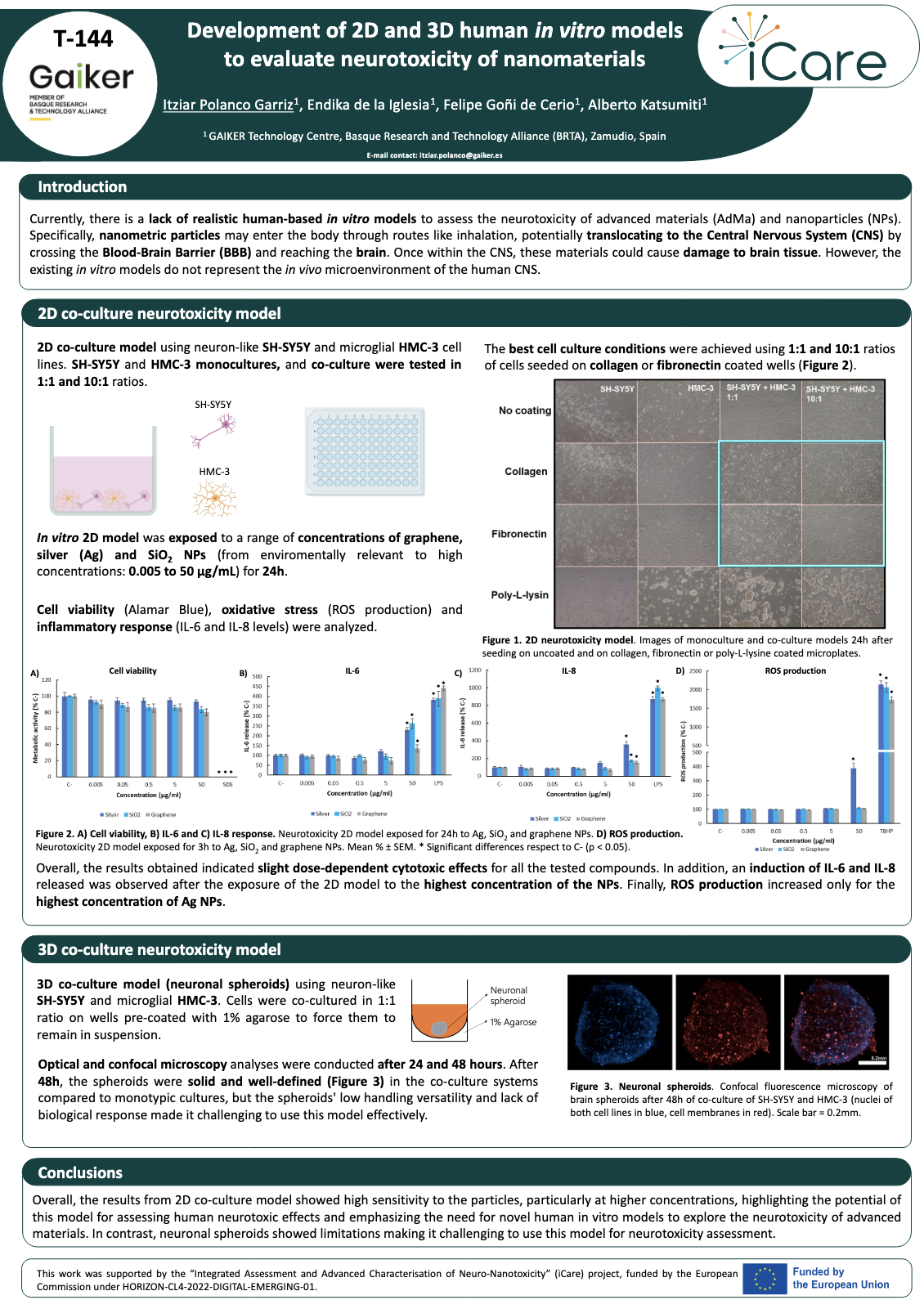
Currently, there is a lack of realistic human-based in vitro models to assess the neurotoxicity of advanced materials (AdMa) and nanoparticles (NPs). Specifically, nanometric particles may enter the body through routes like inhalation, potentially translocating to the Central Nervous System (CNS) by crossing the Blood-Brain Barrier (BBB) and reaching the brain. Once within the CNS, these materials could cause damage to brain tissue. However, the existing in vitro models do not represent the in vivo microenvironment of the human CNS. To study the potential neurotoxic effects, we developed neurotoxicity 2D and 3D co-culture models consisting of neuron-like cells (SH-SY5Y) and microglial cells (HMC-3) to replicate in vivo conditions as closely as possible, incorporating the heterogeneity of different cell populations, while also serving as robust yet sensitive systems to study neurotoxic effects on the CNS. 2D co-culture model was seeded in different seeding conditions (SH-SY5Y and HMC-3 monocultures, and SH-SY5Y+HMC-3 co-cultures in 1:1 and 10:1 proportions) in uncoated 96-well plates and plates coated with collagen, fibronectin and poly-L-lysin. Optical microscopy visualization was performed to determine the optimal seeding conditions. Afterwards, cells were exposed to different compounds (TBHP, LPS, SDS) to test their response and cell viability, ROS production and inflammatory response were assessed. On the other hand, 3D co-culture spheroids were seeded in different cell densities using 96-well plates coated with 1% agarose to generate a low adherence surface. After 24h and 48h, optical and confocal microscopy analyses were performed. Overall, results obtained from 2D co-culture model showed that collagen coating and SH-SY5Y+HMC-3 1:1 co-culture performed best after 24h. On the other hand, results obtained from optical and confocal fluorescence microscopy of the 3D co-culture model after 48h showed solid spheroids in the co-culture models in contrast to the monotypic 3D cultures. However, low versatility on the handling of the spheroids and lack of biological response unabled working with the 3D model. To validate 2D co-culture model for neurotoxicity studies, cells were exposed to a range of concentrations (0.005-50 µg/mL) of graphene (JRC NM488001a, JRC Nanomaterials repository), Ag NPs (agpure W10, HeiQ RAS AG) and SiO2 NPs (NM203, JRC Nnaomaterials repository) for 24h. Cell viability (Alamar Blue), oxidative stress (ROS production) and inflammatory response (IL-6 and IL-8 levels) were analyzed. Overall, results showed great sensitivity to the exposed particles, specially at the highest concentrations, indicating the potential of this in vitro model to assess human neurotoxic effects and highlighting the need for developing novel human in vitro models to study the neurotoxicity of AdMa. This work was supported by the “Integrated Assessment and Advanced Characterisation of Neuro-Nanotoxicity” (iCare) project, funded by the European Commission under HORIZON-CL4-2022-DIGITAL-EMERGING-01.
View the complete poster by downloading the PDF below.