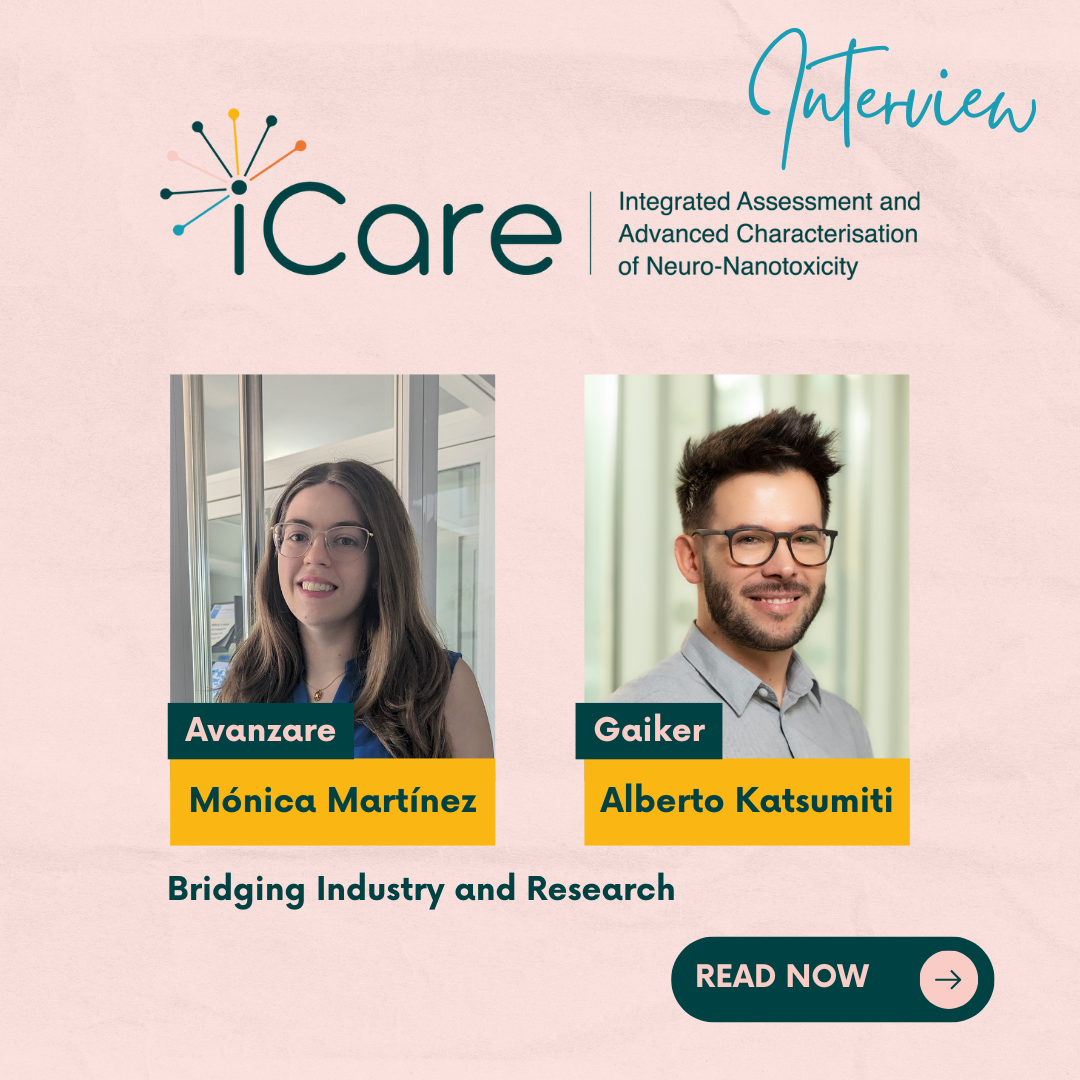
Bridging Industry and Research: Avanzare and GAIKER in iCARE
For the first interview in our iCARE series, we spoke with Mónica Martínez from Avanzare and Dr Alberto Katsumiti from GAIKER. Bringing together industrial and research perspectives, they shared insights into their work on developing and testing advanced materials — particularly graphene-based systems — within iCARE. In this conversation, they discuss their roles, the challenges of working with materials across their lifecycle, and why this work is key to building safer and more sustainable innovation in nanotechnology.
Thank you both for being the first to accept the invitation in our interview series. Could you start by introducing yourself and explaining your role in the iCARE project? Monica, would you like to go first?
MM: My name is Mónica Martínez. I work as technical project manager at Avanzare which is one of the three industrial partners in the iCARE project.
We are a company focused on the development and production of different advanced functional materials. In this project, we work with graphene-based material, which is one of our product lines, although we also produce other types of additives such as antistatic materials and so on.
But, in this project our focus is only on graphene. We provide and use it for two different use cases. One is related to battery casings for electric vehicle, where we use graphene as an additive on the case, which is made with thermoplastic and then, in the other use case, it involves tanks made with epoxy vinyl Ester resin reinforced with glass fiber and graphene.
AK: My name is Alberto Katsumiti. I'm a senior researcher at GAIKER Technology Centre. Our primary role in the project is leading WP2, which focuses on the development of human-based neurotoxicity models for both static and dynamic exposures. We are also involved in other work packages, including WP1, which addresses material characterization; WP3, which focuses on the development of ecotoxicity models; WP4, which manages the project’s data; and WP5, which covers the case studies.
What has been your main focus within the project, and what progress has been made so far in your area of work?
MM: In the two use cases we are leading, we try to develop and obtain different materials along the life cycle of the production of these use cases.
For all the stages of the battery cases and the tanks, it can be really difficult because we need to prepare representative materials from the different stages of production. These materials need to be characterized by the other partners in the project. Sometimes these materials do not fulfil the requirements of the partners tests, and they cannot use them.
AK: The main focus is to develop these neurotoxicity models—both human and ecotoxicity—and to assess their sensitivity to exposure to nanomaterials and real-life case study materials. The work is progressing well: most of the proposed methods are fully established, and we have identified the most sensitive ones for testing with nanomaterials and real-life case study materials. The testing phase has already been completed for some models, while it will be completed shortly for the remaining ones.
You both already mentioned some of the challenges encountered in the project. From your perspective, what have been the main challenges in developing and testing the materials across their lifecycle — and what lessons have you learned along the way?
MM: For us, one of the biggest challenges has been taking representative samples around the lifecycle that can be tested because some materials such as resin are toxic for in vitro testing, so we have need to limit the materials and discard some of them which is really difficult.
Another challenge has been meeting the particle size requirements because for in vitro and in vivo testing they need a particular size below 20 microns. I think the material that we obtain, for example for the thermoplastic materials used in the battery cases, is particularly difficult to obtain at such a low value because the electrostatic effects of the plastic. To solve this, we explore different several approaches including abrasion, sanding techniques, sieving the solid but in some cases the resulting powders were not fully representative of realistic exposure scenarios.
This was one of the biggest challenges for us because we don't achieve easily the requirements for the materials testing.
AK: Our main challenges were related to the testing of the materials. Since some samples were provided in powder form and others in liquid form, we first had to establish dispersion protocols for both human in vitro and ecotoxicity assays that would work for all samples. A second challenge was endotoxin contamination. As these samples were produced for industrial purposes, they were not free from contamination, so we needed to develop strategies to minimize it and enable reliable laboratory testing.
Why do you believe the work done in iCARE is important?
MM: Well, I think that the work carried out in in the project is really important because it advanced the knowledge and the development of different protocols, models, standardization methods for these nanomaterials related with the neurotoxicity, these nanomaterials such as graphene. This graphene for example is particularly relevant because it's an additive that is already entering the market.
For this reason, it is essential to study the safety aspect of these materials using different models and validated protocols and it's important.
AK: There is evidence that nanomaterials can reach the brain. These nanomaterials may reach the brain through inhalation, crossing via the olfactory bulb, or through other routes that allow them to enter the bloodstream, cross the blood–brain barrier, and accumulate in the brain. Although the brain represents a potential target for nanomaterials, there are currently few robust human-based in vitro models available to study these effects. Therefore, the work carried out within the iCare project is highly relevant.
Looking ahead, what can we expect next from Avanzare and Gaiker as part of iCARE’s ongoing developments?
MM: Well, looking ahead from our perspective, I think we expect to gain a deeper understanding of how our materials behave and especially of their potential safety concerns in different matrices throughout the entire lifecycle
This knowledge will help improve material and product development, and support regulatory compliance, while increasing confidence in the safe use of advanced materials.
A key aspect of iCARE is the strong collaboration between all partners. It has allowed us to work closely with experts in advanced testing, characterisation, and the development of new methods. This collaboration ensures that the results are realistic and useful, and it also opens opportunities for future cooperation with partners who have complementary expertise.
AK: From our side, the iCare project offers an excellent opportunity to collaborate once again with Avanzare, supporting the development of safer and more sustainable advanced materials.
Thank you both for sharing your experiences and reflections on your work within iCARE. It was a pleasure to learn more about the industrial and research perspectives that drive this collaboration forward. Your experiences give a great glimpse into the teamwork and progress driving iCARE — and the key roles both Avanzare and GAIKER play in it.