Exploring Cross-Laboratory Collaboration in iCARE
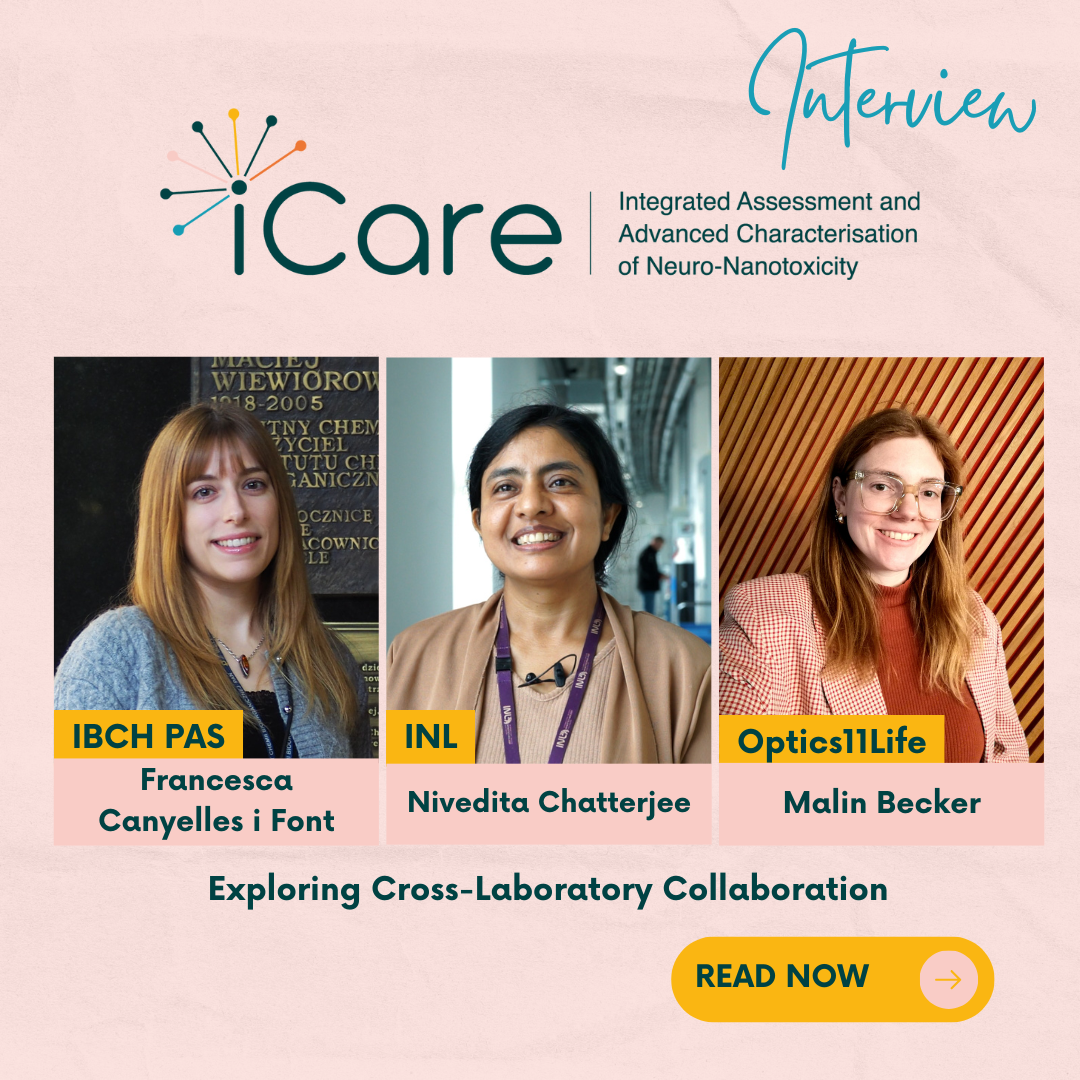
As part of the iCARE project, research teams from across Europe are working together to better understand the impacts of nanomaterials on health and the environment. In this interview, three iCARE researchers — Dr Malin Becker (Optics11 Life), Dr Nivedita Chatterjee (INL), and Dr Francesca Canyelles i Font (IBCH PAS)— share their experiences collaborating across laboratories, integrating mechanobiology into nanosafety research, and advancing methods for evaluating neuro-nanotoxicity.
Could you briefly introduce yourself and describe your role in the iCARE project?
MB: I am Malin Becker, and I represent Optics11 Life within iCARE. Earlier this year, I installed the Pavone Nanoindenter in Poznań and trained the users on-site. I also returned for the training of Nivedita. My main role is to support the users of the system and guide them towards achieving the best possible results.
NC: My name is Nivedita Chatterjee, and I am a research scientist at INL, where I lead Work Package 3 (WP3) within the iCARE project. WP3 focuses on developing ecotoxicological models to assess the environmental health impacts of selected nanomaterials, using both in vitro approaches and bridging models. These models aim to reduce animal testing while also linking human and environmental health risk assessments.
This work package also focuses on developing and validating a series of toxicity assays to address existing gaps in neuro-nanotoxicity. WP3 involves three biological models: C. elegans, planarians, and in vitro fish cell lines. As part of Task 3.2, which integrates mechanobiology into neurotoxicity assessment in C. elegans, I visited IBCH in Poznań to work with the Pavone instrument established there by Optics11 Life.
FCF: I am a chemist with a background in the synthesis and characterization of nanoparticulate systems and fluorescent probes. My expertise includes a range of advanced imaging techniques, such as fluorescence confocal microscopy, super-resolution methods (STED and MINFLUX), atomic force microscopy (AFM), and electron microscopy (TEM, SEM).
Although my background is rooted in chemical and materials sciences, I am expanding my skills in biological disciplines, particularly in generating and preparing biological models for imaging assays. Within the iCARE project, my role focuses on establishing protocols for testing how nanomaterials or advanced materials influence cell rheology (via nanoindentation) and morphology (using confocal and/or super-resolution microscopy) in selected biological models.
What kind of measurements are you performing, and how do these help connect insights from the microscopic (cell-level) scale to the macroscopic level, such as in C. elegans studies?
NC: In C. elegans, we measure mechanobiological endpoints, specifically the stiffness of the living organisms using nanoindentation, both with and without exposure to selected nanomaterials. This endpoint is highly relevant, as changes in mechanical properties are closely linked to health status, ageing progression, and age-related diseases.
By combining these measurements with mechanobiological data obtained from in vitro cell models, we aim to bridge insights from the microscopic ((sub)cellular) level to the macroscopic (whole-organism) level. Ultimately, integrating data from both models will allow us to evaluate whether interspecies predictive models can be developed to support safety and risk assessment of selected nanomaterials in humans.
FCF: At IBCH PAS, I perform single-point indentations on biological samples using the Pavone instrument (Optics11 Life), targeting cytoplasmic regions adjacent to the nuclei in models relevant to nanoneurotoxicity. The indentation data provide quantitative mechanical properties (Young’s Modulus) at the cellular level, which we correlate with morphological imaging to study how nanomaterials may influence cellular structure and function.
Nivedita, you recently travelled to Poznań to work on measurements — could you share a bit about that experience and the collaboration with the local team? Francesca, from your side, how was it to host Nivedita and collaborate during her visit?
NC: My visit to IBCH in Poznań was a very positive experience. I was warmly welcomed by the entire team, especially by Francesca. Excellent technical support and training were provided by Optics11 Life, particularly by Malin. Overall, the collaboration was highly effective, and we were able to complete all planned tasks and experiments as scheduled.
FCF: Hosting Dr Nivedita Chatterjee at IBCH PAS was an exceptionally positive experience. Her visit provided a great opportunity to integrate her deep biological expertise in C. elegans with our existing methodological framework. At the same time, we were supported by Dr Malin Becker from Optics11 Life throughout the entire process with Pavone — from installation and troubleshooting to optimising protocols and workflows.
Having all parties on-site during the visit allowed for real-time exchange of insights, which significantly accelerated our progress in establishing robust indentation protocols and adapting sample preparation workflows for the C. elegans model.
What did you find most rewarding or challenging about working across labs and exchanging expertise within the project?
MB: It was great to see how our device can be applied to such different samples. It is always rewarding to develop protocols together with the researchers and discuss the potential meaning of our findings. The challenges often lie in organisation and communication, but Francesca did a great job in making sure everything ran smoothly.
Exchanging expertise and building new foundations of knowledge in other fields is one of the most exciting parts of my work, so this collaboration was a real pleasure.
NC: The most rewarding aspects were learning to handle new instruments and meeting teams from other laboratories while working within the same European project. The mechanobiology aspect is an emerging and innovative field in health and toxicology, and it has not been widely explored using the C. elegans model. From a technical perspective, we are among the pioneering groups applying these endpoints in C. elegans within nanosafety.
At the same time, a key challenge was working in a new laboratory for a short period, as adapting to different laboratory rules, workflows, and practices within a limited timeframe was not always easy.
FCF: The most rewarding part was working with passionate individuals from related fields and broadening my technical and conceptual skills beyond conventional 2D cell culture models.
The main challenge was coordinating an efficient timeline that met everyone’s needs, particularly when preparing specific consumables and C. elegans strains. However, through proactive communication and collaboration, we successfully completed all planned measurements, making the experience both fruitful and professionally enriching.
Looking ahead, what are the next steps or goals for your research in iCARE?
NC: The project is still ongoing, but we are now approaching the end of the experimental phase. The next key step is to deliver the generated data to the data science team, who will use it to develop predictive models as part of iCARE.
FCF: The goal of my subtask is to compare imaging techniques (nanoindentation and confocal/STED microscopy) with cell viability results to select the best methods for capturing cell structure and mechanical responses to neurotoxic or neuroinflammatory stimuli.
My immediate focus is on optimising the bimodal imaging assay to robustly quantify how nanomaterials and advanced materials affect cell morphology and rheology — potential markers of neuro-nanotoxicity. So far, I have tested several pristine nanomaterials within the neurotoxicity model, yielding valuable baseline data. Next, I will validate the protocol further and test selected industrial nanomaterial samples using the same biological model, while also extending the workflow to an additional biological model of neuro-nanotoxicity.
Thank you, Malin, Nivedita, and Francesca, for sharing your time and insights. It was a real pleasure to hear about your collaboration, the challenges you tackled together, and the exciting progress you’re making within iCARE. Your enthusiasm and teamwork truly capture what this project is all about.