Inside the Lab: How IIT is Tackling Nanomaterial Neurotoxicity in iCARE
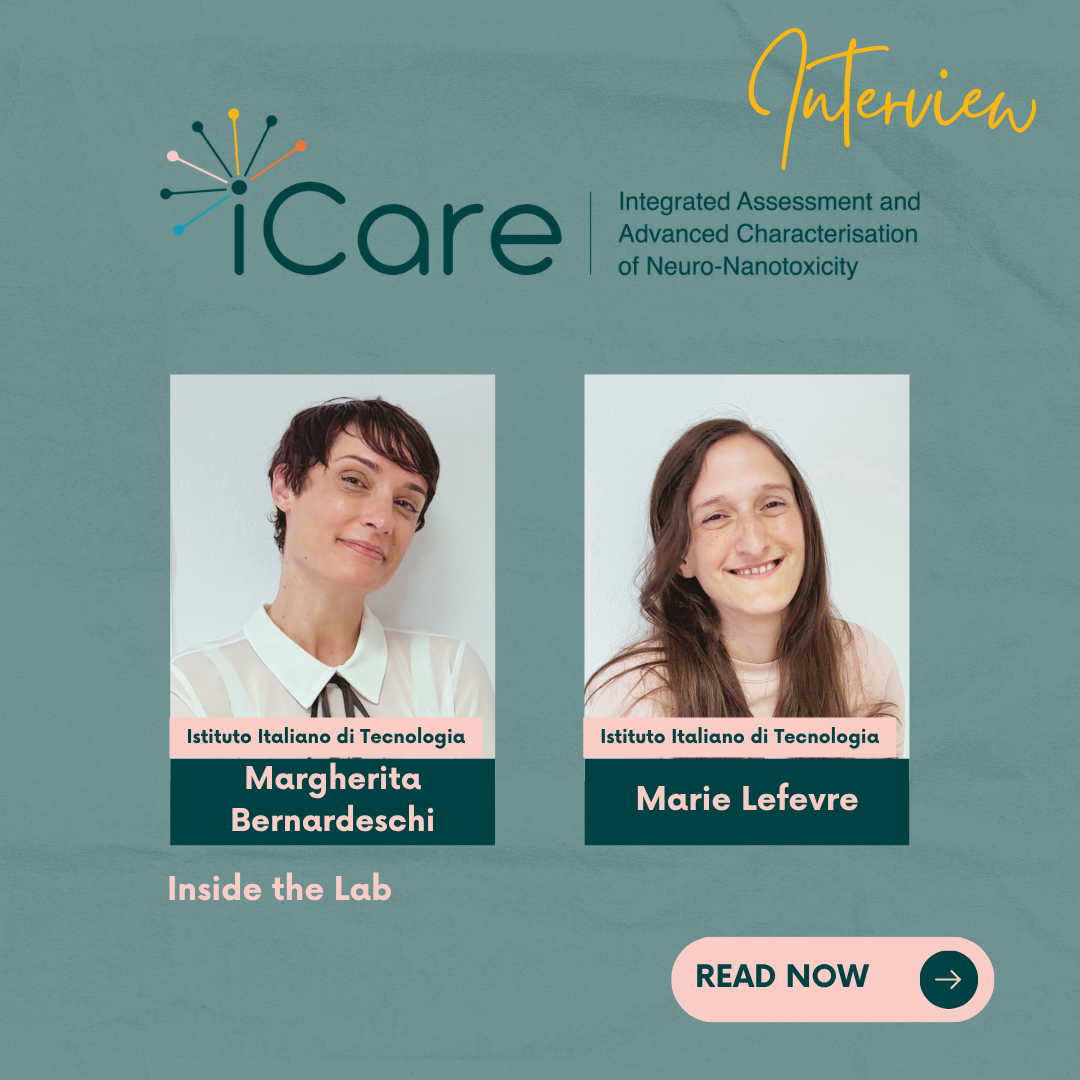
As part of the iCARE project, research teams from across Europe are working together to better understand the impacts of nanomaterials on health and the environment. In this interview, two iCARE researchers — Dr Marie Celine Lefevre and Dr Margherita Bernardeschi (Istituto Italiano di Tecnologia) — share their work developing complementary models for nanosafety assessment, from in vivo planarian experiments to a 3D microfluidic blood-brain barrier platform, and how these approaches come together to evaluate the neurotoxicity of graphene-based nanomaterials.
Could you briefly introduce yourselves and describe your respective roles within the iCARE project?
MB: I am a marine biologist and ecotoxicologist, and I obtained my PhD in 2011 from the School of Medicine at the University of Pisa. My research has focused on environmental screening and monitoring campaigns aimed at assessing the effects of both conventional and emerging pollutants on wildlife and human health. Since 2022, I have been a laboratory technician in the Smart Bio-Interfaces Research Line, led by Gianni Ciofani. Within iCARE, my work centres on in vivo experiments using the flatworm Schmidtea mediterranea as a sentinel species. The animals are chronically exposed to graphene-based particles produced by the industrial partners and then analysed for survival rate, genetic damage, and neurobehavioural alterations.
ML: I have been a postdoctoral researcher since 2023 in Gianni Ciofani's Smart Bio-Interfaces Laboratory at the Italian Institute of Technology. I trained as a chemical engineer specialised in life sciences and biotechnology, and completed my PhD in Bioelectronics in 2022 at the École des Mines in southern France. My research has focused on 3D pathological and non-pathological models, including organ-on-chip platforms, particularly for brain-related applications. Within iCARE, I am developing a 3D microfluidic blood-brain barrier model to assess the neurotoxicity of nanomaterials. This perfused platform integrates non-invasive sensors for real-time monitoring of barrier integrity, and I am also involved in studying nanomaterial effects through proteomic analyses.
Why were planarians chosen for iCARE, and what unique advantages do they offer for assessing the environmental and health impacts of nanomaterials?
MB: Planarians were chosen because they are highly sensitive sentinel organisms that bridge environmental and health-related toxicology at the whole-organism level. They have a well-organised body plan, a centralised nervous system, and molecular pathways conserved with higher organisms — which makes it possible to investigate not only general toxicity, but also specific endpoints such as neurobehavioural alterations, regeneration defects, and genetic damage. From a practical standpoint, they are easy to culture, inexpensive to maintain, and well-suited to reproducible in vivo testing across multiple materials and exposure conditions. Their transparency further facilitates the observation of morphological and physiological changes. Taken together, planarians offer a rare combination of ecological relevance, biological sensitivity, and translational value for nanomaterial risk assessment.
What specific nanomaterials are you testing, and what endpoints are you using to detect nanotoxicity?
ML: The nanomaterials under investigation are graphene-based materials sourced from representative industrial samples. In planarians, we focus on three main endpoints: toxicity, assessed through survival rate; genotoxicity, evaluated by detecting primary DNA damage using the diffusion assay; and neuronal impairment, measured through neurobehavioural assays tracking changes in speed and motility.
In the microfluidic model, the focus is on barrier integrity, monitored by measuring transendothelial electrical resistance (TEER). This involves applying a low-intensity alternating signal across the barrier and measuring the impedance generated by the cells. A drop in TEER typically indicates a loss of barrier integrity and impaired function.
Could you explain what the BBB microfluidic model is, why it is relevant for nanosafety research, and how it complements the planarian work?
ML: The BBB microfluidic model reproduces the interface between a cerebral blood vessel and the brain. Compared to conventional in vitro models, it is designed to be more predictive by combining 3D organisation with dynamic flow conditions. The platform includes a perfused channel mimicking a blood vessel, connected to static brain chambers via an array of pillars where endothelial cells form the barrier. In the brain compartment, astrocytes — which play a key role in BBB function — are cultured in 3D within a hydrogel. The vascular channel can be connected to a pump to expose the barrier to flow, and nanomaterials can be introduced into this circulation. Built on glass to enable microscopy, the chip also integrates thin-film electrodes for non-invasive TEER monitoring. Where the planarian model captures responses at the whole-organism level, the BBB chip allows us to study functional effects in a human-relevant system — which is precisely what makes the two models so complementary.
How are the data from both models feeding into predictive modeling, and what are the next milestones before the project concludes?
MB: The two models contribute to predictive modelling at different but complementary levels. Planarians provide whole-organism data on survival, regeneration, behaviour, and genetic damage, while the BBB microfluidic model offers mechanistic, human-relevant insight into how nanomaterials interact with the blood-brain barrier under dynamic conditions. By integrating these datasets, we aim to link organism-level toxicity with barrier-specific functional effects, ultimately building a predictive framework that strengthens the assessment of both environmental and human health risks. By the end of the project, the goal is to translate results from both platforms into actionable conclusions about the toxicological profile of the nanomaterials investigated.
Thank you, Marie and Margherita, for sharing your time and insights. It was a real pleasure to learn about your work and how your two models come together to advance nanomaterial safety assessment within iCARE. We look forward to seeing where these approaches lead as the project moves towards its final stages.