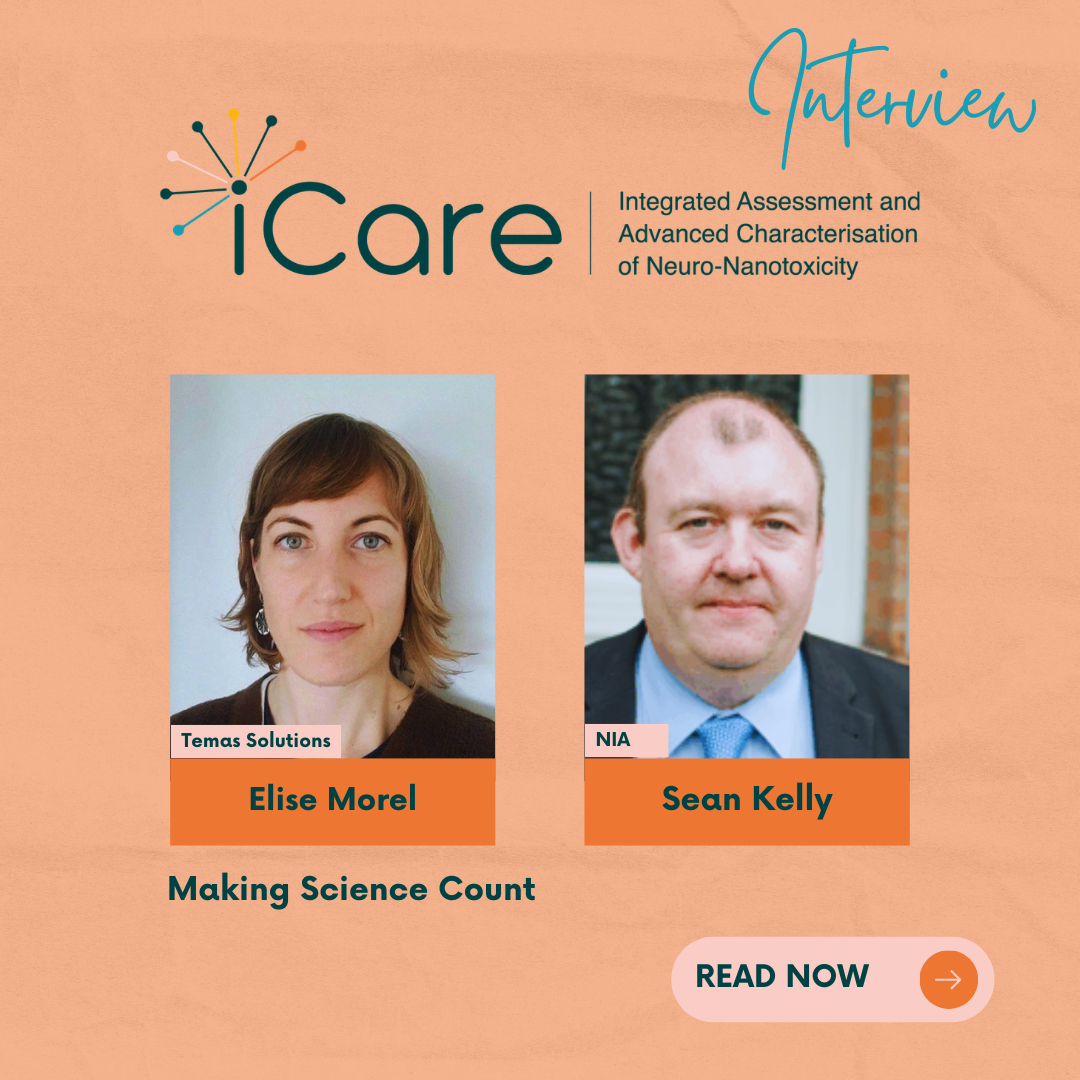
Making Science Count: NIA and TEMAS Solutions on Stakeholder Engagement in iCARE
As part of the iCARE project, research teams and industry partners from across Europe are working together to establish the techniques and methodology for evaluating Advanced NanoMaterials and Composites (ANMC) in relation to neuro-nanotoxicity.. In this interview, Elise Morel (TEMAS Solutions) and Sean Kelly (Nanotechnology Industries Association) — representing the scientific and communication sides of the project respectively — share their experiences engaging stakeholders across industry, regulation, and policy, and reflect on how external input is shaping the project's path towards real-world impact.
1. Could you briefly introduce yourself and describe your role in the iCARE project?
EM: I am Elise Morel, a scientific consultant at TEMAS Solutions. Within iCARE, I work with scientists from academia, industry, and regulatory bodies to evaluate the applicability and industrial relevance of assays developed to assess the neurotoxic potential of graphene-related 2D materials and their composites. We contribute to pre-validation activities by collecting Standard Operating Procedures (SOPs) and datasets to support future European standards. In parallel, neuro(eco)toxicity data generated through high-throughput and high-content methods — from molecular to functional assays, using brain derived cell line from human and fish and in vivo invertebrate models — are evaluated to refine grouping and read-across approaches, targeting cost-effective regulatory compliance of these nanomaterials and related nano-enabled products.
SK: My name is Sean Kelly, and I am the Interim Director General at the Nanotechnology Industries Association. In iCARE, the NIA leads the project's communication, dissemination and exploitation activities. We ensure that project results, news and events are publicised and promoted to all stakeholders and the general public, managing channels such as the project website and social media, and working closely with all partners to make sure project news is shared in a timely and impactful way.
2. Which stakeholder groups have you engaged with, and how did you identify the most relevant voices?
EM: We have engaged with industry actors, regulators, policymakers, and standardisation bodies, prioritising those involved in regulatory decision-making, standardisation, and the industrial application of graphene-related materials — actors who could both contribute to and benefit from project outcomes. Key milestones include the co-organisation of the Joint Regulatory Risk Assessors Summit at the OECD in June 2025 and participation in annual harmonisation and standardisation workshops, which have opened sustained communication channels with national and international standardisation bodies. At the DPP4EU2025 conference in Brussels, iCARE engaged with European Commission Directorates-General to advance integration of safety data generated by EU research projects into digital product passport, while continued stakeholders involvement is ensured through targeted workshops, including the May 2026 on grouping and read-across of advanced (nano)materials.
SK: On the communication side, we already had strong foundations to build on. Through the NIA's existing involvement in bodies such as the OECD's Working Party on Manufactured Nanomaterials (WPMN) and ECHA's Nanomaterials Expert Group (NMEG), we could reach regulatory stakeholders quickly. As a trade association, the NIA also brings together members from both industry and research, and project partners further extended our collective reach across end users and policymakers through their own networks. Rather than starting from scratch, iCARE has been able to plug into these existing relationships from the outset.
3. What methods have you used to involve stakeholders, and what has worked well or less well?
EM: Stakeholder engagement has primarily been conducted through workshops and discussion-based formats — platforms where participants can share practical experiences with regulatory compliance and express needs around test standards. Strong participation has been built through collaborative efforts across multiple EU projects, which has been one of the most effective aspects of our approach. The main challenge remains translating those discussions into concrete, harmonised outputs. As iCARE approaches its final phase, we are consolidating its legacy through a SOP catalogue and public reports covering neuronanosafety testing, IATA, and computational tools for grouping and read-across — a process that requires sustained coordination beyond the project's duration.
SK: Beyond the organised events Elise mentioned, the project has also benefitted from more informal engagement — through NIA's participation in working groups and conversations at industry events such as IndTech 2024 and the Advanced Materials Show. These lighter-touch interactions are harder to measure but often generate candid feedback that structured workshops do not always capture. What has worked particularly well overall is the pooling of networks across projects: by co-organising events with sister projects, we reach a far broader and more diverse audience than any single project could on its own.
4. Has stakeholder input shaped any aspect of the research?
EM: Yes, directly. Industry feedback identified practical constraints for implementing iCARE assays in industrial settings — particularly the need for specialised equipment and expertise, and the lack of in-situ methods. Regulatory stakeholders provided guidance on validation and acceptance of New Approach Methodologies (NAMs), notably through frameworks such as the Tracking System for Alternative Methods Review, Validation and Approval (TSAR) and the European Union Reference Laboratory for Alternatives to Animal Testing (EURL ECVAM), while input on ISO-aligned physicochemical characterisation helped refine our integrated approaches to testing and assessment (IATA). Together these contributions ensure the methods being developed are not only scientifically robust, but practically usable.
SK: To add to that, one recurring theme from stakeholder conversations has been the gap between laboratory conditions and real-world industrial samples. Methods developed in iCARE are often built around pristine, laboratory-produced nanomaterial samples, which can differ significantly from what industry actually works with. Hearing this directly from industrial stakeholders has helped partners think more concretely about how their methods need to evolve to remain relevant — and ultimately exploitable — after the project ends.
5. Looking ahead, what role do you hope external actors will play in translating iCARE's outcomes into impact?
EM: As iCARE moves into its final phase, stakeholder involvement needs to shift from consultation towards implementation. Regulators, standardisation bodies, and industry will be central to the validation, standardisation, and regulatory acceptance of the methods developed — including SOPs, IATA frameworks, and grouping and read-across strategies. Sustained engagement beyond the project's lifetime will be essential to ensuring iCARE's results genuinely contribute to safer and more sustainable innovation in advanced nanomaterials.
SK: From a communication standpoint, the priority is making sure that what has been developed is not only accessible but understood. The SOP catalogue will be a key resource for future standards work and will help align iCARE outputs with the ongoing work of bodies like the OECD WPMN. But beyond formal outputs, iCARE will keep building its conversations with industry, academia, policymakers and regulators — because the real measure of the project's success will be whether the science finds its way into practice and ultimately benefits the people it was designed to protect.
Thank you, Elise and Sean, for sharing your perspectives. It was genuinely interesting to hear how stakeholder engagement operates at both the scientific and communication levels, and how the two reinforce each other. As iCARE moves into its final phase, it is clear that the conversations built throughout the project will be just as important as the results themselves.