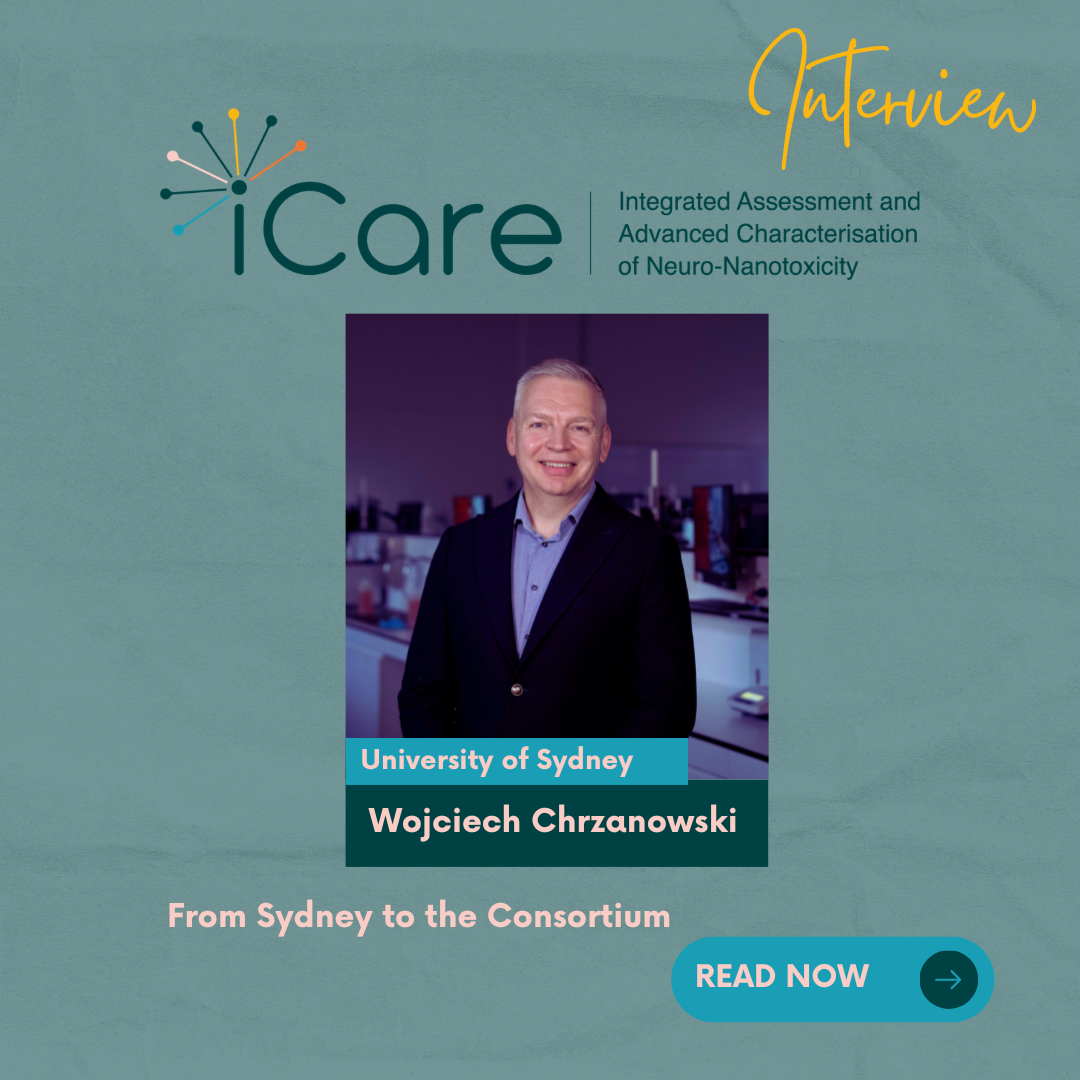
From Sydney to the Consortium: Nanosafety, Bacteria, and the Global Reach of iCARE
Nanosafety research rarely stops at the lab door, and it rarely stays within a single continent. Professor Wojciech Chrzanowski, iCARE's international partner based at the University of Sydney, brings a perspective that spans nanomedicine, nanotoxicology, and cutting-edge imaging, as well as a regulatory context that extends well beyond Europe. In this interview, he discusses what it means to study how living systems respond to graphene, why bacteria matter as much as cells, and how building models that industry can trust has become the defining goal of this work.
Could you introduce yourself and describe your role within the iCARE project? What is your research background, and how does your expertise in nanomedicine at the University of Sydney contribute to the project's goals around nanosafety and health impact assessment?
I am Wojciech Chrzanowski, a professor of Nanomedicine at the University of Sydney, specialising in nanosafety, nanotoxicology, and new approach methodologies/non-animal technologies. My work centres on understanding how cells, bacteria, and more complex organ-like systems respond to nanomaterials, and how we can use those nanomaterials for therapeutic purposes. In our lab we build multi-organ models, e.g. lung, gut, skin, and their interactions with the immune system, to study how nanomaterials behave across different biological environments, and to use that knowledge to design strategies for organ regeneration or protection. This sits squarely within the longevity medicine area that defines the remit of iCARE.
A core part of my work is assessing the safety of different classes of nanomaterials and developing methods to do that rapidly, reproducibly, and reliably, which aligns closely with the iCARE mission. Within the project, I am the international partner based in Australia, one of the initiators of the programme, and my role is to support the consortium, contribute expertise, and conduct experiments.
You are collaborating with Avanzare on the bacteria–nanomaterial interface. Could you tell us more about that work and why it matters?
When studying any nanomaterial, it is important to understand its interactions not only with cells but also with microorganisms. Graphene, which is central to iCARE, has varied safety profiles, and in our work we focus on how it affects different types of bacteria, their growth and biofilm production in particular.
This matters in two contexts: graphene as a potential antimicrobial material, and graphene's interactions with the microorganisms that make up our environment, including soil, water, and the human body, which is as much microbial as it is cellular. In our lab we look at whether graphene offers antimicrobial activity and how it influences bacterial behaviour, because understanding both sides of that picture is essential.
Your microscopy work with Jacek and the teams at IBCH Poznań and IIT is a significant cross-institutional effort. What has that collaboration looked like in practice?
With both institutions I had prior interactions and a good sense of their capabilities, which complement ours well. We bring different tools to the same problem, different resolutions, scales, and modalities. Our focus is on fluorescence-free microscopy: holotomography, infrared spectroscopy, and nano-infrared spectroscopy. These complements the fluorescence-based methods used by Jacek and the IIT team. Analysing the same samples across multiple modalities gives a far richer picture than any single technique or any one of us working alone could achieve.
As the only iCARE partner outside Europe, what challenges has that brought, and what does being based in Australia add to the consortium?
Honestly, the reality is that we can collaborate from pretty much anywhere. Time zones require some adjustment, but iCARE was wonderful in organising meetings I could attend. There are occasional extra costs around shipping, and biosecurity can complicate receiving materials, but my overall experience has been fantastic. The knowledge exchange and the building of international capacity have been phenomenal.
Each partner brings a specific perspective, and it is that collection of expertise that makes the consortium work. We contribute high-end imaging capabilities, along with expertise in the legal and regulatory aspects of nanomaterials, our framework here differs from Europe's, which adds something useful. It also means we can think about how iCARE's results travel beyond Europe and reach society more broadly.
Looking ahead to the final phases of iCARE and beyond, where do you see this research heading?
The main direction is creating models that industry can apply, not just biomedical, but any industry using nanomaterials, to test and assess materials rapidly and reliably. But it is also about building trust. With growing scepticism around science, producing robust, transparent evidence is itself a contribution. The project is heading towards well-established models that can be applied across the board.
Beyond that, we are moving towards a more holistic strategy, looking not only at mammalian cell models but at aquatic and wider environmental systems. Combining cells and bacteria adds real value, especially as these materials may find new applications we have not yet imagined. It is not just about the models, but about keeping the door open for what comes next.
Thank you for sharing all of this so openly. It is clear that nanosafety is not something bolted on at the end here, it runs through everything, from how experiments are designed to how the team thinks about where this field is heading. There is a lot to look forward to.